There was a time when a “good” day on a weight-loss journey meant seeing a smaller number on the scale.
Now, people are starting to ask a different question:
“Do I actually feel better?”
Can I get through the afternoon without needing three cups of coffee? Can I climb the stairs without feeling exhausted? Can I wake up feeling refreshed instead of already counting down to bedtime?
That shift is more important than it sounds.
Because losing weight while feeling tired, hungry, and drained doesn’t necessarily feel like winning. And for someone juggling work, family, workouts, and everyday responsibilities, having enough energy to actually live matters.
This doesn’t mean weight loss has stopped being important. For many people, reducing excess body weight can improve health.
But the definition of progress is becoming bigger.
People want to feel lighter, stronger, more energetic, and more capable, not simply lighter on the scale.
As seen on Shark Tank India
Muskan lost 15 kg in 90 days.
You could be next.
4.5 ★★★★★
Facebook Rating
Book your consultation
Why Are People Moving Beyond the Number on the Weighing Scale?
Imagine two people who have both lost 5 kg.
One feels energetic, sleeps well, has fewer cravings, enjoys workouts, and can get through the day without constantly thinking about food.
The other has also lost 5 kg, but feels tired, hungry, irritable, and unable to maintain the routine that helped them lose weight.
The scale says they both succeeded. Their bodies tell a very different story.
This is one reason energy is becoming a more meaningful health goal. Weight is one measurement, but it doesn’t tell you everything about what is happening inside the body. It doesn’t show your sleep quality, muscle strength, fitness, nutritional adequacy, stress levels, or how easily you can sustain your daily routine.
Energy, on the other hand, is something people experience every day.
Can you climb stairs without feeling exhausted?
Can you concentrate through the afternoon?
Do you wake up feeling refreshed?
Can you exercise without feeling completely drained afterward?
These questions provide useful clues about overall well-being.
Physical activity itself is strongly connected with health. WHO recommends that adults get 150–300 minutes of moderate-intensity activity each week, along with muscle-strengthening activities on at least two days.
Importantly, physical activity is not limited to gym workouts; it includes walking, cycling, household activities, and other movement. The goal, therefore, isn’t to stop caring about weight. It’s to put weight into context.
A healthier approach is to improve energy, strength, nutrition, and metabolic health while allowing healthy weight changes to happen as part of the process.
At Fitelo, the focus is not just on helping you lose weight, but on building eating habits that support your energy, routine, and long-term health.
Can Your Diet Make You Feel More Energetic Without Constantly Counting Calories?
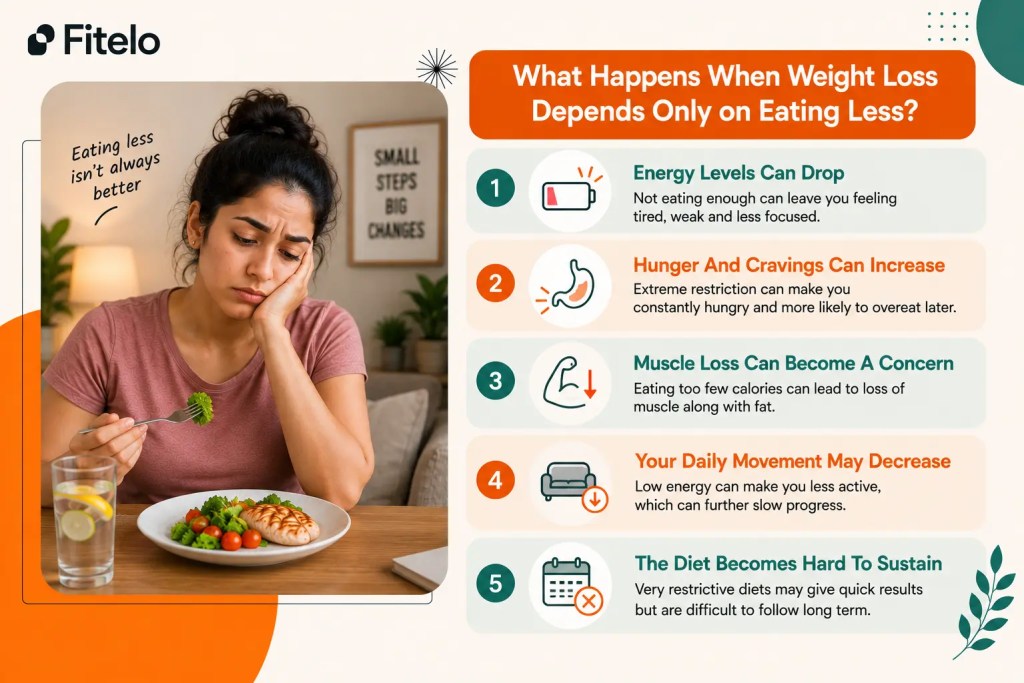
Here is a common mistake: when people want to lose weight, they immediately start cutting food.
Breakfast gets smaller. Carbohydrates disappear. Snacks are eliminated. Portions become extremely restrictive.
Initially, the weighing scale may move. But then comes the afternoon slump, intense cravings, and the feeling that you have absolutely no energy left.
That is not necessarily a sign that you need more willpower. Sometimes, your eating pattern simply isn’t supporting your body’s needs.
Your body needs carbohydrates for readily available energy, protein to support muscle and repair, fats for essential functions, and micronutrients involved in energy production and metabolism. Water matters too.
This is why a weight-loss diet should not simply mean “eat less.” It should mean eat strategically.
A balanced Indian meal could include dal, vegetables, curd, roti or rice, and an appropriate protein source. Breakfast could combine protein and fibre instead of relying entirely on refined carbohydrates. Snacks can include options such as fruit with nuts, roasted chana, curd, or other protein-rich choices depending on individual needs.
And there is another important point: persistent tiredness shouldn’t automatically be blamed on weight.
For example, vitamin B12 deficiency can cause tiredness and weakness, while B12-deficiency anaemia can also cause symptoms such as dizziness and shortness of breath.
So if fatigue is persistent, the solution isn’t necessarily another restrictive diet. It may require looking at food quality, meal timing, sleep, stress, and possible nutritional or medical causes.
The better question is not “How little can I eat?”
It is “How can I eat appropriately while creating a sustainable calorie deficit?”
Fitelo helps turn weight loss into a practical eating routine, so your meals support your goals without leaving you constantly hungry or drained.
As seen on Shark Tank India
Muskan lost 15 kg in 90 days.
You could be next.
4.5 ★★★★★
Facebook Rating
Book your consultation
Why Are Sleep, Stress and Movement Becoming Part of the Energy Conversation?
You can eat a nutritious diet and still feel exhausted if the rest of your lifestyle is working against you.
Think about the familiar cycle: you sleep late, wake up tired, skip breakfast or grab something quickly, depend on caffeine, feel sluggish in the afternoon, and have little motivation to exercise. By evening, you’re exhausted but still scrolling on your phone. Then the cycle starts again.
This isn’t simply a weight problem.
It’s an energy-management problem.
Sleep is particularly important. The CDC recommends that adults aged 18–60 get at least 7 hours of sleep per night, and good-quality sleep is essential for physical health and emotional well-being.
Movement matters too, but it doesn’t have to mean an intense one-hour gym session every day.
A 20–30 minute walk, taking the stairs, household chores, stretching between work sessions, or strength training a few times a week can all contribute to your overall activity.
WHO also emphasizes that some physical activity is better than none, and adults should gradually build toward recommended activity levels rather than feeling they must suddenly become extremely active.
Stress deserves attention as well. When your day is packed with work pressure, poor sleep, and irregular meals, healthy habits become harder to maintain. You may crave highly palatable foods, skip workouts, and struggle with portion control, not because you lack discipline, but because your routine is exhausting.
This is why a sustainable health plan needs to consider the whole lifestyle.
Instead of asking, “How can I burn more calories today?” ask:
“What can I change today that will help me feel better tomorrow?”
Sometimes the answer is an earlier bedtime. Sometimes it’s a proper lunch. Sometimes it’s a walk after dinner.
Those small changes add up.
With Fitelo, weight management can go beyond food alone by helping you build realistic habits that fit your daily routine and support long-term consistency.
Can Focusing on Energy Actually Make Weight Management More Sustainable?
This is where the biggest shift happens.
When weight loss is the only goal, every decision can feel like a test. The scale hasn’t moved, you ate dessert, missed a workout, or gained 500 grams, and suddenly, you feel like you’re failing.
But what if progress meant more than weight?
Maybe you’re waking up with more energy, managing cravings better, walking without getting exhausted, sleeping more consistently, or feeling stronger during workouts. Even when the scale moves slowly, these are meaningful signs that your health is improving.
This mindset can also make healthy habits easier to maintain. Instead of following an extreme diet for a few weeks, you focus on habits that work even when life gets busy.
Try tracking more than your weight:
- Energy levels throughout the day
- Hunger and cravings
- Sleep quality
- Daily movement
- Strength and fitness
- Meal consistency
- Waist measurements
- Weight trends over time
The weighing scale still matters, but it shouldn’t be your only measure of success. The better goal is: “I want to feel stronger, more energetic, and healthier while gradually reaching a weight I can maintain.”
Fitelo focuses on sustainable lifestyle changes that support healthy weight management without making the weighing scale your only measure of progress.
A Word From Fitelo
The way we think about weight loss is changing.
People still want to lose excess weight, but increasingly, they also want something they can feel every single day: more energy, better sleep, fewer cravings, improved strength and the ability to actually enjoy their routine.
And that is a healthier way to look at progress.
Because a smaller number on the weighing scale doesn’t automatically mean better health. A successful approach should help you eat better, move more comfortably, sleep well, and feel capable of getting through your day.
The solution isn’t to ignore weight completely. It is to stop making weight the only destination.
When nutrition, movement, sleep, stress management, and sustainable habits come together, healthy weight management becomes part of a bigger picture.
And perhaps that is the real goal, not simply to weigh less, but to live better with more energy to enjoy the life you’re working so hard to build.
As seen on Shark Tank India
Muskan lost 15 kg in 90 days.
You could be next.
4.5 ★★★★★
Facebook Rating
Book your consultation
Frequently Asked Questions
Is Energy More Important Than Weight Loss?
Energy and weight are both useful health indicators, but neither should be viewed in isolation. Feeling energetic, sleeping well, maintaining muscle, eating adequately, and having good physical fitness can provide a broader picture of wellbeing than body weight alone.
Why Do I Feel Tired Even When I Am Losing Weight?
Fatigue during weight loss can happen when calorie restriction is too aggressive, meals lack adequate protein or nutrients, sleep is poor, hydration is inadequate or stress is high. Persistent or unexplained fatigue should also be discussed with a healthcare professional because nutritional deficiencies or other medical conditions can contribute to tiredness.
Can Eating Too Little Reduce Energy Levels?
Yes. Excessive calorie restriction can make it harder to meet your body’s energy and nutritional needs. A sustainable weight-loss plan should create an appropriate calorie deficit while still providing sufficient protein, fibre, vitamins, minerals and other essential nutrients.
How Much Sleep Do Adults Need For Better Energy?
Most adults aged 18–60 should get at least 7 hours of sleep per night, according to the CDC. Sleep quality and consistency also matter, not just the number of hours.